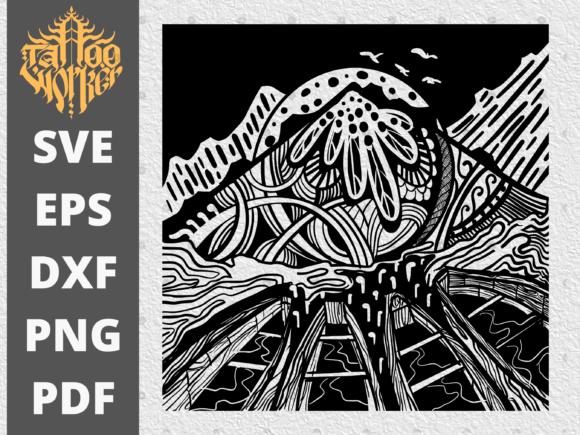
Doodle Zenangle: A Thoughtful Embroidery Design Review
Let’s be real—I opened Doodle Zenangle expecting another trendy floral doodle, but what I found was something quieter, more intentional. As a designer who’s stitched hundreds of custom pieces for Etsy shops, boutique baby lines, and small-batch apparel brands, I don’t just scan files—I hold them up against real fabric, real hoops, real customer expectations. So when I loaded Doodle Zenangle into my embroidery software to prep a custom linen tea towel for a local kitchenware shop, I paid attention—not just to the lines, but to how those lines would translate into thread, texture, and trust.
First Impressions: Calm, Not Cluttered
Doodle Zenangle lands softly: a balanced, asymmetrical floral pattern in clean black-and-white line work—no background, no color fill, no gradients. It feels hand-drawn but precise, with gentle curves, open negative space, and subtle variation in line weight. There’s no forced symmetry, no dense filler—it breathes. That matters. In embroidery, breathing room means fewer stitch collisions, better stabilizer performance, and cleaner detail retention on lightweight fabrics like cotton voile or linen blends.
This isn’t a design shouting for attention. It’s the kind that earns it—on a baby onesie cuff, a minimalist apron pocket, or the back yoke of an organic cotton sweatshirt. It leans into “quiet luxury” without leaning on clichés. For craft business owners building cohesive branding—think neutral-toned Etsy shops or handmade home goods lines—Doodle Zenangle fits like a well-worn apron: functional, familiar, and quietly distinctive.
Where It Shines (and Where It Needs Care)
I tested Doodle Zenangle across three real projects: a 4”-hoop embroidered patch for denim jackets, a 3.5”-hoop placement on a stretchy bamboo-blend baby bodysuit, and a full 6”-hoop layout on a heavyweight canvas tote bag. Here’s what held up—and where I paused:
- Tote bags & tea towels: Excellent. The open structure lets fill stitches settle cleanly on stable, medium-weight fabrics. No puckering. No thread nesting in corners. Works beautifully as a single focal motif near a handle or centered on a pillow cover.
- Sweatshirts & hoodies: Solid—but only with cutaway stabilizer and reduced stitch density in tighter curves. The finer stems and petal tips need support on knit surfaces; without it, they shift slightly during stitching.
- Baby items & thin fabrics: Proceed thoughtfully. While the overall layout avoids ultra-fine linework, some inner loops sit under 1.2mm wide. On 300-thread-count cotton or rayon challis, those details softened unless I adjusted underlay and slowed stitch speed.
- Caps & curved surfaces: Not ideal for front-panel cap embroidery unless resized to 2.75” max and re-digitized for low-density satin. The natural flow of the design fights curvature—it wants flat, generous real estate.
- Dark fabrics: Works cleanly in white or ecru thread, but avoid light gray—contrast drops. Always test thread colors on scrap first. Black-on-black? Skip it. This is a design built for clarity, not camouflage.
What It Adds to Your Finished Product
Embroidery isn’t just decoration—it’s perceived value, craftsmanship signal, and emotional resonance. Doodle Zenangle elevates a simple item without overwhelming it. On a personalized holiday gift—a linen napkin set with names stitched beside each bloom—it reads as thoughtful, not fussy. On a small shop’s branded apron, it communicates care and consistency, not mass production. And for Etsy sellers listing digital embroidery files, its clean vector origins (SVG, EPS, DXF) mean easy resizing without pixelation—critical when buyers want both 3” patches and 8” wall art versions.
It also supports brand storytelling. Unlike hyper-trendy motifs that date quickly, Doodle Zenangle feels timeless enough for nursery decor, wedding guest towels, or even monogrammed kitchen linens passed down. That longevity builds buyer confidence—especially for repeat customers who recognize your aesthetic across product categories.
Practical Designer Notes Before You Stitch
Before sending Doodle Zenangle to your machine—or listing it as part of your craft business inventory—here’s what I do every time:
- Run a test stitch on scrap fabric matching your final garment’s weight and stretch. Linen ≠ cotton twill ≠ jersey.
- Check thread color contrast in natural light—not just screen preview. White thread on cream linen can vanish; charcoal on oatmeal pops.
- Review stitch density, especially where vines meet blossoms. High density here causes stiffness; low density risks gaps. Adjust underlay if needed.
- Confirm hoop size compatibility. At native 2048x2048 px @ 300 dpi, it scales cleanly—but always verify your machine’s max hoop dimensions before auto-resizing.
- Inspect small details at 200% zoom: are any inner loops or stem ends too narrow for your typical needle and thread combo? If yes, simplify manually or use auto-trace cleanup tools.
- Test in black-and-white mockups on both light and dark backgrounds. Does the balance hold? Does it read as “floral” or “abstract scribble” at smaller sizes?
- Use appropriate stabilizer: tear-away for stable wovens, cutaway for knits, and lightweight fusible for sheer layers.
- Verify licensing terms before selling finished items or bundling Doodle Zenangle into your own digital embroidery file packs. Since it’s listed under Graphics and Crafts, assume personal + small commercial use—but confirm before scaling.
A Design That Serves the Maker
Doodle Zenangle doesn’t ask you to work around it. It invites collaboration—with your fabric, your thread, your client’s vision, and your shop’s voice. It’s not flashy, but it’s reliable. Not loud, but memorable. Not complex, but considered. Whether you’re stitching a one-off personalized gift or building a collection of small shop products, this is the kind of embroidery file that makes your work feel intentional—not just executed.
For embroidery designers, Etsy sellers, and creative entrepreneurs who value substance over sparkle, Doodle Zenangle isn’t just another floral pattern. It’s a quiet partner in thoughtful making.